
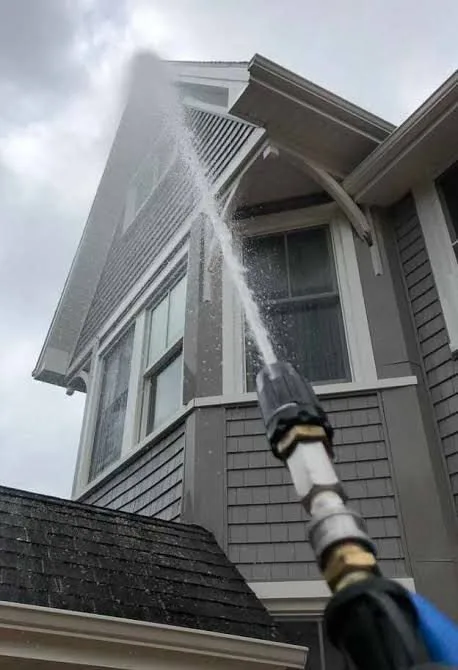
The difference between soft washing and pressure washing comes down to what does the cleaning. Soft washing uses low pressure and lets a cleaning solution do the work; pressure washing uses the force of the water itself. The right choice depends on the surface, and most Houston homes have some of each.
That means the question is rarely soft washing or pressure washing for the whole property. It is which method belongs on which surface, and getting it wrong can cost more than a dirty exterior ever would.
How each method works
Soft washing applies a cleaning solution at low pressure, closer to a strong garden hose than a pressure washer. The solution kills and loosens algae, mildew, and other organic growth, and everything is then rinsed away. This is what Gleam Clean’s house washing service uses on siding, trim, and other painted or coated surfaces.
Pressure washing works the opposite way. A machine forces water out at high pressure (commonly somewhere in the 1,500 to 4,000 PSI range), and that mechanical force physically blasts grime off hard surfaces. Soft washing runs at a small fraction of those numbers. In one method the solution does the work; in the other, the pressure does.
Surfaces that should only be soft washed
Roofs are the clearest case. High pressure strips the protective granules off asphalt shingles, shortens roof life, and can void the manufacturer’s warranty. If you are seeing black streaks on the roof, that is roof algae, and it calls for low-pressure roof washing, never a pressure washer.
Siding belongs here too. Vinyl, the Hardie and fiber-cement boards common in newer Houston builds, painted brick, and stucco can all be damaged by pressure: it can force water behind siding panels, chip paint, and gouge soft mortar joints. Wood fences and decks also do better with soft washing in most cases, since pressure raises the grain and etches wand lines into the boards.
Surfaces built for pressure washing
Concrete driveways, sidewalks, patios, and pavers are hard mineral surfaces, and the grime that works into them (tire marks, mildew ground into the pores, the gray film that builds up over a Houston summer) needs force to come out. This is where pressure washing earns its place. Even here, the pressure and nozzle should match the surface; older or previously patched concrete takes a lighter touch than a newer slab. Pool decks and curbs generally fall in the same category, though anything sealed or decorative deserves a test spot first.
Why the difference matters more in Houston
Most of what makes a Houston exterior look dirty is alive. Gulf humidity feeds algae, mildew, and mold year-round, and organic growth responds to solution, not force. Blasting algae off siding without treating it removes the visible layer and leaves the organism behind, which usually means faster regrowth. The wall looks clean for a season, then streaks again sooner than it should. Treating the growth is what keeps siding and rooflines looking clean longer.
What this means for your home
Walk the property and most Houston homes sort themselves quickly: soft wash the roof, the siding, the fence, and anything painted; pressure wash the driveway, the walkways, and the patio. Many homes need both in a single visit, which is normal. The point is not picking one method, but matching each method to the material in front of it. A crew that shows up with one machine and one setting for every surface is a warning sign worth taking seriously.