
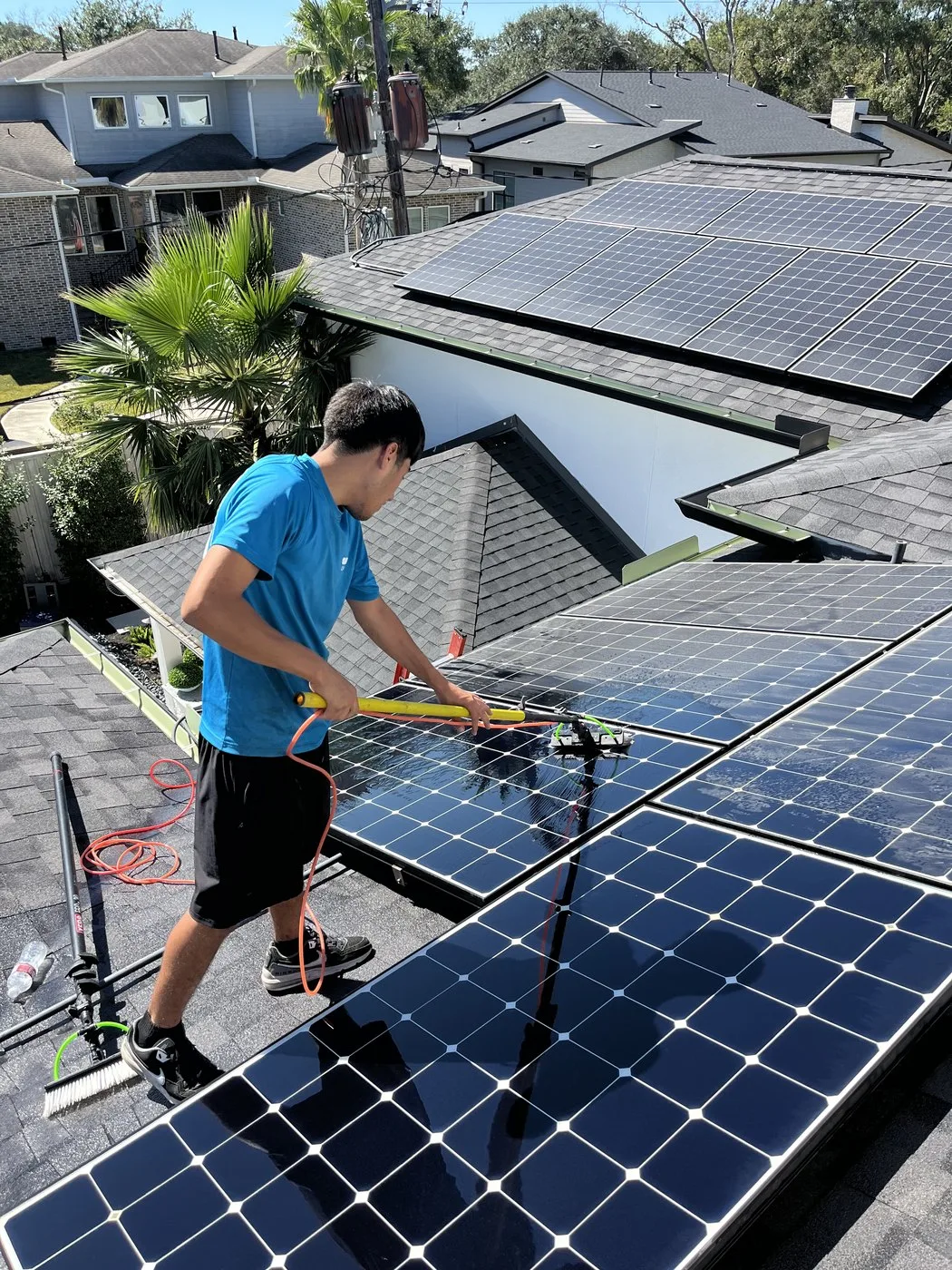
Yes. Most solar panels in Houston benefit from periodic cleaning, even though rain does part of the job. A good downpour rinses off loose dust, but it leaves behind pollen film, mineral spots where rainwater or sprinkler overspray dries on hot glass, bird droppings, and a band of grime along the lower edge of each panel where runoff collects. For most Houston homes, once or twice a year is a typical rhythm. Panels under trees, near construction, or in areas where pollen film builds visibly usually need attention more often. That gap between what rain removes and what panels collect is what professional solar panel cleaning covers.
What rain cleans off and what it leaves behind
Rain is a rinse, not a wash. It carries away the loose material sitting on top of the glass, but anything stuck to the surface stays put. Pollen forms a film that water beads over rather than dissolves. Bird droppings harden in the sun. And because rainwater itself carries dust and dissolved minerals, it often dries into faint spots, especially on panels that are already warm when the shower ends.
The lower edge of each panel is the telltale spot. Runoff drains toward it, slows at the frame, and drops its sediment there. Over time that builds into a dirt band no weather will remove. Panels on a steep, open, rain-exposed roof with no trees nearby can stay acceptably clean for longer stretches. Most Houston roofs are not that lucky.
Why Houston’s calendar works against clean panels
Spring is the messiest season. Live oak pollen coats everything from roughly February through April, and the film it leaves on panel glass does not go away on its own. Summer heat bakes it on, so by July and August the residue is harder to remove than it was in May.
Then hurricane season, June through November, layers on its own mess. Storm winds push leaves, twigs, and grit across rooftops, and debris tends to collect along the seam where panels meet the roof. And August is peak production season, when panels work hardest, which makes it a poor month for spring’s leftovers to still be sitting on the glass.
How panels should be cleaned
Solar panels should never be pressure washed, scrubbed with abrasive pads, or cleaned with harsh detergents. The glass carries an anti-reflective coating that aggressive methods can damage, and many panel warranties exclude that kind of harm. The appropriate approach is soft brushing paired with a pure, deionized water rinse. Because the water carries no dissolved minerals, it dries without leaving spots, no squeegee or drying pass required. It is the same water-fed method used in professional exterior window cleaning, applied to a more delicate surface.
Cleaning panels also means working on a roof, over fragile and expensive glass, often with a long pole and running water. That combination is why many homeowners hand this job off. If the shingles around the array are streaked or mossy, roof washing can address the surrounding roof at the same time.
Honest expectations about energy output
Dirty panels do produce less than clean ones; a layer of film between the sun and the cells has a cost. But be wary of any company promising a specific percentage gain from cleaning. The real number depends on how dirty the panels were, how they are tilted, and the season, so any figure quoted sight unseen is a guess. An honest cleaning pitch is about restoring clarity to the glass, not quoting output numbers invented for the sales call.
What to watch for from the ground
You do not need to climb anything to know it is time. Look for visible film or spotting on the glass from the yard or street, a dirt band along the bottom edge of the panels, bird droppings, or debris collecting where the panels meet the roof. If the glass looks dull from the driveway, it looks worse up close, and it has probably looked that way to the sun for a while.